Well, I have to be honest but the GWHS Fall Battle was a bit of a bore for me. First, for a variety of reasons, none of other unit members showed up so it was just me. Also, work on the bunker has hit a series of snags to some corrective work will need to be done before we can go further. Finally, with a messed up right arm (severe muscle strain), I was unable to do much in the way of moving with the rifle, wielding a pistol, or throwing grenades so I remained in a defensive position for most of the battle. I wasn't even able to get pictures since my camera battery died unexpectedly.
I spent most of the battle in a bunker with the one lone member of the 1st Jaeger Batallion so together, we represented Bavaria. The battle wound up ending early, around 9:30 pm or so (the norm is usually midnight or thereabouts), and that was it. Overall, it was pretty much a waste of time. Hopefully things will go better in the spring.
2 Chevauleger Banner

Monday, November 10, 2014

Friday, November 7, 2014
Close Call...
Horses by biology are prey animals whose first reaction to anything potentially life-threatening is to run. Much of this can be mitigated by training and rider skill but there's always just a remnant of the horse's biology and even with the most extensive training, horses can and do react to stimuli. The key is to train the horse to be be able to recover from the negative stimulus. In the picture below, the horse is reacting to the explosion of a shell landing close by. Of course what we don't know is if the horse than ran away or remained in place (relatively).
From the looks of things, it appears that the rider is handling things but it can still be quite a scary experience since there's the potential that the horse could flip over, crushing the rider, or fall to the side and pinning the rider (and breaking bones). Either way, things are pretty dicey here.
From the looks of things, it appears that the rider is handling things but it can still be quite a scary experience since there's the potential that the horse could flip over, crushing the rider, or fall to the side and pinning the rider (and breaking bones). Either way, things are pretty dicey here.
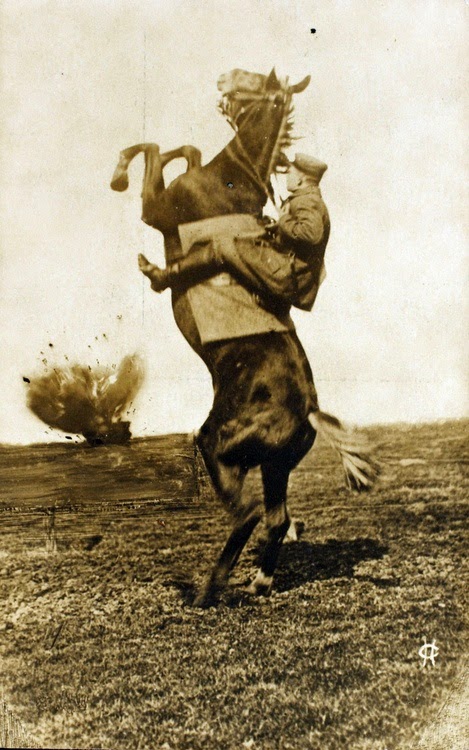 |
| Horse reacting to shell fire. |
Thursday, November 6, 2014
Off to the Fall Battle...
I will be incommunicado for the new few days while I attend the Great War Historical Society Fall Battle Event at King's Crossing. When I come back, I should have some interesting pictures to post. In the meantime, enjoy this:
 |
| Bavaria needs you! Help fight the barbarian hordes! |
Wednesday, November 5, 2014
More Cavalry Illustrations
Sometimes, there are not a lot of specific Chauleger illustrations available so one must make use of other types of cavalry to "fill in the gaps" or at least provide a useful analolgy. This is especially true in the case of "action" shots or depictions of cavalry in the field. Below are some examples.
While each of the above picture is relatively unexciting and even mundane, they still reveal a lot of details about the cavalry's daily existence.
 |
| Cavalry formation, unit unknown, on the move. |
 |
| Cavlary, most likely Uhlans, in a trench. Interestingly enough is a Madsen machinegun being manned by one soldier. The Madsen machingun was used by the Russian Army in a limited number and the Germans captured many of them and issued them to cavlary for dismounted work (by the nature of their original function, they tended to lack the firepower necessary to function as infantry). From the helmets, this is late war, probably 1917/18. |
 |
| 13 Hussar Regiment crossing a river on March 8, 1915 in Kurland in what is today Lithuania. |
 |
| Cavalry, unit unknown, Poland, June 28, 1915. The unit is clearly at rest. On the Eastern Front, cavalry still retained many of its tranditional functions. |
Tuesday, November 4, 2014
Cavalry at Play
Below is an iteresting picture on several levels: first, it's an action shot; second it's late war from the Stahlhelms; and it's cavalry. The unit is unknown but it's clear that some sort of a competition or demonstration was going on, judging from the large audience.
Pictures like this are priceless...the hunt continues.
Horrido!
 |
| Cavalry practicing with padded lances. From the helmets, it's no doubt 1917-18 but we don't know the location or the unit. This was probably either a demonstration or a competition, judging from the large audience. |
Horrido!
Comments Welcome!!
All-
Sometimes I feel like this one lone voice in the wilderness...please feel free to comment on my blog entries, add information, etc. One of the intentions behind this blog is share information in regard to the German Cavalry of the First World War era and going back somewhat to around 1900 or so.
Danke!
Sometimes I feel like this one lone voice in the wilderness...please feel free to comment on my blog entries, add information, etc. One of the intentions behind this blog is share information in regard to the German Cavalry of the First World War era and going back somewhat to around 1900 or so.
Danke!
Cavalry Illustrations
In our attempts to recreate German cavalry of the First World War era, one of the first places we turn to are period photographs and illustrations. Unfortunately for us, while there are abundant single and group portraits of Chevaulegers, there's a dearth of shots of them in the field or in action (but that I would expect). As with everything else in this blog, I try to pick out more interesting pictures and not just an endless parade of portraits. Also, in our attempts to build more convincing, authentic portraits, we try to study pictures to draw our ideas from. Combined with the official regulations, it helps to build up a more complete profile. Of course, as with all historical things and especially living history, this can only be a work in progress as we attempt to approximate the "real thing." Naturally, we can not get to the final destination since we were not those original soldiers but I think we can come close with diligent effort and a willingness to adapt when our ideas are changed or proven wrong.
 |
| Chevauleger group, regiment unknown. This first picture is interesting for a couple of reasons. First, the Chevaulegers are wearing puttees, which is consistent with cavalry's changing role as the war progressed. Also, this is one of the few known pictures in which Chevaulegers are wearing Stahlhelms (helmets), something decidely late war, either late 1917 or 1918. Also, the Chevauleger second from the left in the rear is holding a GEW 98 as opposed to the Kar 98a which was standard issue for cavalry. These are just some initial observations. |
 |
| Chevauleger NCO, regiment unknown. From the collar braid and the large collar disks, this is a sergeant. He's wearing the distinctive cavalry belt and bayonet (mostly hidden by the tunic pocket. The bayonet or Seitengewehr ("sidearm") was standard for all soldiers, even cavlary and a sword knot would be worn with it denoting the sergeant's rank. The NCO is wearing a private purchase visored cap, similar to an officer's cap but not stiffened and with a different cockade. This would be considred "walking out" dress, a uniform that was worn when the soldier was off duty but going into town, away from the Kaserne. He's wearing the 1915/16 Bluse per the 1916 regulations. |
 |
| Enlisted Chevauleger, regiment unknown. Here's another interesting picture of a Chevauleger in walking out dress. The Chevauleger is wearing ankle boots and puttees, and of course, his bayonet. Here, the Chevauleger is wearing the 1908 tunic. |
 |
| Two Chevaulegers, 8 Chevauleger Regiment. This is most likely an early war picture, perhaps 1914-15. Both of them are wearing sword belts with sword hangers. By late 1915, the sword had been retired from front line use and the hanger straps also disappeard. Interestingly enough, they are not wearing their bayonets. The boots are most likely the 1915 pattern Universal Bavarian cavalry boot. |
Subscribe to:
Posts (Atom)