2 Chevauleger Banner

2 Chevauleger Banner
Showing posts with label cavalry. Show all posts

Sunday, June 21, 2015

The Canteen/Die Feldflasche, Part 4

As a follow-up to the last installment in this series, I have finally managed to get an accurate reproduction of the cavalry, or more properly artillery, canteen. Below is are pictures of the reproduction which is essentially an infantry pattern canteen with the appropriate straps and harness added afterwards. This canteen also has unit markings appropriate for the 2 Chevauleger. :-) 


Below are pictures of an original for comparison:


Note that in the top example, there is no cross-strap running across the canteen towards the top. In the next examples, the canteen used is the 1915 pattern and it does have a cross-strap at the top. Also, all the straps are ersatz.  


The version I had reproduced follows more of the second pattern. I opted for this since I felt that it would provide a bit more strength and stability for the harness, especially because of the strain caused by the weight of the water and that it would be moving violently on my person in the course of action and it's not unreasonable that 1907 canteens were used with the later 1915 pattern harness.

This is a welcome piece of kit and I hope to have some more made so as to equip the unit.

Horrido! 

Friday, May 22, 2015

On The Eastern Front

By December 1914, the great movements of the armies in the West had ended and the situation had settled into a stalemate that was more the product of mutual exhaustion than anything else. For the cavalry, the opportunity for large sweeping movements and attempts to out-flank the enemy were over. Up until the last months from August to November 1918, cavalry in the West played a limited role (although there are a few interesting episodes such as at Cambrai in 1917).

However, in the East the situation was dramatically different. With a front extending over a 1000 miles, the stalemate characteristic of the Western Front never set in quite the same way (by way of comparison, the Western Front was roughly 475 miles long). Often fronts formed as a result of mutual exhaustion between movements and with the right amount of concentration of forces, a breakthrough was achievable.

For the cavalry, conditions on the East Front were very conducive to cavalry operations even on the strategic level and there were numerous opportunities to carry out its traditional roles of reconnaissance, screening, and attacks on rear area formations. 

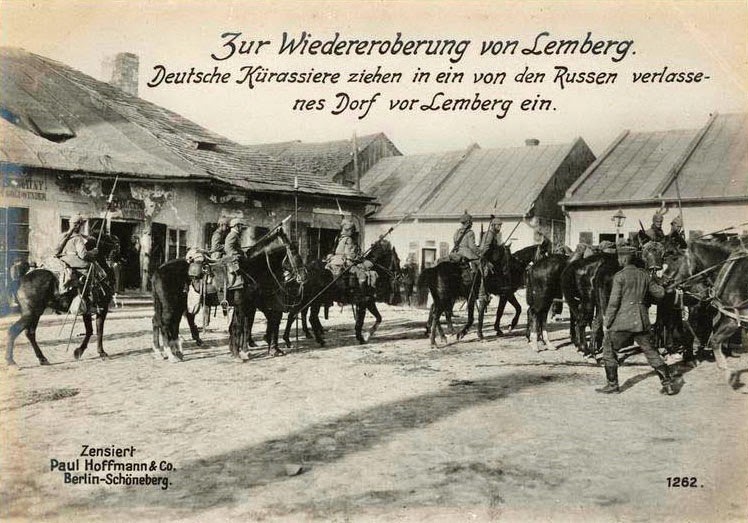
Below are a few pictures of cavalry on the Eastern Front:

Cavalrymen of the Leib-Dragoner-Regiment No. 24 resting near Lyduvėnai, Russia (today, located in Lithuania), 24 May 1915. Image taken by Gustav Victor Lachmann, an officer in the regiment.
From the collection of the Imperial War Museum, © IWM (Q 115279).‪
  
The recapture of Lemberg. Dragoons (unit unidentified) entering the city.

Uhlans (regiment unidentified) escorting POWs during the Battle of the San River in Galicia/Gorlice-Tarnow Offensive of May,1915, 

Now you are probably wondering how the 2 Chevauleger ties into this. Essentially, the 2 Chevauleger remained in the West during the war except for the 1 Eskadron which was detached from the regiment in April 1915 and sent to the Eastern Front. Specifically, it was assigned as the divisional reconnaissance element for the 11th Bavarian Infantry Division which had be formed in March 1915. The 1 Eskadron served with the 11th on the Eastern Front and later the Serbian Front until the division was transferred back to the West in March 1916 for the Battle of Verdun. The 1 Eskadron rejoined the regiment in March 1916 (the remainder of the 2 Chevauleger was stationed nearby to Verdun).


So yes, while we have a tenuous relationship with the Eastern Front as a unit, it is still relevant in that it presents a contrast in the way cavalry was used.


Horrido!  


Sunday, May 17, 2015

The Official 2 Chevauleger Official History - Part Five - The Battle for France

And now the fifth installment of the history of the 3rd Eskadron/2 Chevauleger Regiment. This covers the German 1918 Spring Offensive from March 21, 1918 through April 6, 1918 and this is just the first part, more will follow. What is interesting is that the 3 Eskadron's primary mission was communications, most principally acting as dispatch riders. Other tasks were assisting with telephones and carrier pigeons. Unfortunately, not much hard information about the 3rd Eskadron is given so one really has to search for those occasional "nuggets" of useful information.

From a living history/reenactment perspective, the most useful tasks that could be performed during an event would be acting as messengers, manning field telephones, and perhaps acting as Feldgendarmerie. As the unit grows and develops, one or several of these activities will be incorporated in to what we do as a unit. Naturally, as more information is discovered, this is subject to change. For now, enjoy an interesting piece of history- it is doubtful that this has ever been previously translated into English and it's highly unlikely that this history has been actually read by anyone in the past 50 to 70 years (or at least I'd like to think so). It's truly a find.

Horrido!

********************************************************************************************
The Battle for France: March 21, 1918 - April 6, 1918  

During January and February the command authorities and staffs began to feverishly prepare for the great attack with the strictest secrecy under the code name “Michael”. As with mobilization in peacetime, the battle had been prepared with German thoroughness and conscientiousness. Equally, the assault divisions were eagerly training to operate in this greatest of all battles. From February 25, 1918 on, the commands proceeded with organizing the accommodations and preparations for the attack in the deployment area. On 14 March, the assault divisions were ordered into their assembly areas. In order to avoid detection from the air, all the troop movements were performed at night. So moved the 6th Bavarian Infantry Division and the 3rd Squadron in night marches through Mir (?), Waziers, Sin le Noble and went into a bivouac at Hamel, where it arrived during the night of March 19/March 20.

During the time that diversionary attacks were being made on other fronts, the 17, 2, and 18 Armies attacked along the general line of Bullecourt (west Cambrai) – La Fere to break through at Amiens and attack the enemy force at Abbeville. The 6th Bavarian Infantry Division assigned now to the 17th Army, Group Lewarde (General Command, XVIII Army Corps) and was in the second attack behind the 234th and 221st Infantry Divisions at Agincourt. After a successful breakthrough, the 6th Bavarian Infantry Division was inserted into the gap between the two aforementioned divisions that had characterized arise that had the group recoil Lewarde north to bring the east Arras standing enemy front light for shrouds. (?)

During the night of March 21, the dense fog that had fallen broke at 3:30 am in the front. On the entire front, the tremendous fire of the German artillery went first, the enemy was fighting back with gas and explosive ammunition, and the lines of communication were occupied with gunfire. By 4:00 am, the fire spread to the enemy infantry positions. Thousands of minenwerfers now joined this artillery fire at 9:40 am in front, supporting the infantry in the attack, while the artillery "rolling fire" was time-controlled, rolling forward precisely. The enemy artillery answered reluctantly and at the first onset of the enemy was to be followed across the board over the rough field funnel through enemy obstacles of their own infantry. Countless pioneer companies were burdened and they succeeded only with great delay to pave the way so that the infantry could move forward.

At 12:40 pm, after the 6th Bavarian Infantry Division with the 6th and 10th Infantry Regiments was inserted between the 234th and 221th Infantry Divisions, and had taken Ecourt (?) to be advancing against Groifilles. Another advance was impossible because our artillery could only follow each attack stage slowly.

The 3rd Squadron had to provide the infantry and artillery headquarters staffs with sufficient dispatch riders reporting and to provide a number of police patrols, who had the hugely important task of taking care of the accumulation of forces ordered on the route of advance. In addition, the squadron led by Captain Meyer initially [reporting to head had am Kocher dig spell](?) to extend south to the extent of Bullecourt and Ecourt which had to follow, depending on the progression of the infantry by leaps and bounds. The connection with the reporting of division staff chiefs had the Division telephone detachment, the connection of signaling head with the regiments and the artillery make the subject ends troops. The connection with the reporting of the division staff chiefs was through the Division telephone detachment, connecting the signaling chief with the regiments and the artillery and in the end, the troops. Since the wire, which could not be set high (i.e., on poles) in a short time, failed even in this attack as a result of enemy action and the inevitable damage caused by our own vehicles, especially Raupenlaftkraft cars. The burden of messaging rested on the entourage of all the technical equipment (blinkers, radio operators, telephones, alarm dogs, pigeons) and finally ended on the shoulders of our brave dispatch riders.

The command had secure internal reporting channels and in important cases, the orderly officers of the Division were usually using the officers of our regiment. Lieutenant D. R. Wirth earned the Iron Cross First Class. The message center acted as an advanced element, moving up in accordance with the progression of the attack instead of the Division Headquarters (?).

In crossing over the shelled area, especially with horses, it could only be correctly termed as difficult as the entire field strength had to ride this ordeal. First, our own deep trenches had to be overcome, then the terrain between the two positions with a tangled mess of mutual wire obstacles and then the enemy first position that was crisscrossed by deep trenches and churned thoroughly with shell holes by the hour-long barrage [sat at shell hole](?).

In addition, there was heavy enemy fire on the crossing points! Well the Pioneer Companies struggled to put bridges over the trenches and corduroy roads to provide with prepared material. However, it succeeded in doing so after a few days; in just the first few hours, a movable way would have been crucial. By the evening of 21 March only a few Feldgeschüke (artillery piece of some type?) had come slowly and with unspeakable exertions over the shelled area. The first heavy Geschüke (?) could be pulled on March 23 only gradually. Undaunted and unceasingly, our dispatch riders had to cross this desert with its snares. When it was no longer possible to ride, they ran on foot with their messages.

On the first day (March 21, 1918), Chevauleger Auernhammer[1] was killed while acting as a dispatch rider at the 10th Infantry Regiment when his horse was wounded in the leg by a grenade. On March 24, Chevauleger Donauer[2] was wounded by shrapnel in the shoulder. The fallen and the divisional staff and their baggage were located in Ecourt and Lt. Schmid was in command of the division headquarters. At night, there was gas throughout the bivouac area. Frequently these bivouac areas had to be changed due to enemy fire. 

Food, especially for the horses, was extremely difficult to obtain; roughage did not exist. Water was supplied by specific cars. In the enemy's position itself, there was little to be found. The whole supply of munitions and food moved along the only route of advance for the two divisions, which was only passable at long intervals and with great difficulty. Ammunition was more important than the food.

Page from the Official 2 Chevauleger Stammrolle for Chevauleger Auernhammer. 

Page from the Official 2 Chevauleger Stammroll for Chevauleger Donauer


[1] Johan Karl Auernhammer, b. January 1, 1891; Home of Record: Niederhofen; Stammrolle No. 19
[2] Joseph Donauer, b. March 25, 1893; Home of Record: Langenthonhausen, Obpf.; Stammrolle No. 267.

Friday, May 8, 2015

Cavalry Operating on Horseback

This picture often makes the rounds online, Unfortunately, not a lot is known about it and the specific unit not identified. It is most likely that this picture was taken on the Western Front sometime from 1917 on. Note that the sword has been dispensed with (in 1915, an order issued by the high command directed that swords were not be carried anymore). Also, the soldiers' carbines are now being carried slung over their shoulders rather than on scabbards.


Thursday, May 7, 2015

New Cavalry Picture

Here is an interesting picture that I cam across today of an unidentified unit, most likely Western Front from 1917 on, judging from the stahlhelms. Note the one soldier in the front right appears to be wearing grenade bags along with the rest of his kit. It also appears they are wearing rucksacks and one has a pommel bag strapped to the rear. 

From all the excess equipment and the rucksacks that the soldiers are carrying, it would appear that this unit was making an administrative move rather than a tactical move with combat a possibility.


The photographic evidence above supports what Kraus' findings in regard to rucksack use by the cavalry and provides yet more documentation to support our impressions. It's little details like this that help up to do a better job with our living history.

Horrido! 

Tuesday, May 5, 2015

West Coast Militaria Show

Just to let you all know that the 2 Chevauleger will be setting up a display at the West Historical Militaria Collectors Show at the Fairplex in Pomona, CA on Saturday, May 9 from about 9 am to 4 pm or so. We will have some displays of uniforms and equipment so if you want to check us out in person, come on by, we would be happy to meet with you. :-)
Horrido!
At last year's show.

Monday, April 20, 2015

Riding Breeches/Reithosen, Part 2

To continue our story, one characteristic of both the 1908 and 1916 pattern Reitosen or riding breeches is that they are minimally tailored. Beyond the legs gradually tapering in, there is little of the extreme lines one normally expects with riding breeches or the more extreme lines found with officer's breeches.

1916 Pattern Reithosen, Front View-  Note the gradual tapering o the leg and that the leather seat extends down most of the leg.

1916 Pattern Reithosen, Rear View- Once, again, this is a relatively untailored garment and is in no way form-fitting.

Line Drawing of the 1916 Pattern Reithosen
So, as it can be seen from the above pictures, the Reithosen were generously cut and were intended for practical use out in the field. These were not designed to look good for parades and in fact, they go against popular concepts of what cavalry uniforms should look like. Wars will do that. 

Perhaps some of the confusion stems from the Reithosen being confused with Stiefelhosen,which were a more tailored fitted garment. The enlisted version of the Stiefelhosen were originally issued to soldiers assigned to machine gun detachments. Later, they were also issued to mountain troops and field artillery. Below is a line drawing of the enlisted 1908 pattern Stiefelhosen:

1908 Pattern Stiefehosen
But even here, there is not much difference between these and the Reithosen. 

Just for comparison, here is what people normally associate with cavalry breeches:

Second World War Era Officer Breeches. The extreme tapering from the hips to the legs is evident. This type of styling was characteristic of officer uniforms and was also in existence during the First World War.

In the end, more research will have to be done but it is safe to say that the Reithosen was a loosely fitted garment intended for practical use in the field.

The New Chevauleger Uniform

It's been quiet here for awhile so here's an update of the latest from the 2 Chevauleger. As many of you know, obtaining the proper uniforms has been a recurring problem almost since the unit was originally formed in 1997. At first, converting vintage Swedish Army tunics from the 1940s was the way to go but at best, this was a half-way solution that was makeshift at best. Sure, the outline of the proper 1909 tunic was achieved but that was about it. The color and the wool were completely off and when lined up next to a proper tunic, the differences are obvious. But, it was all we had at the time and there was no real alternative, especially since nobody in the group had any tailoring skills and there was nobody in the marketplace willing to attempt the project except at an exorbitant price. It also did not help that we did not have an original 1909 tunic to work off of.

With the unit dissolving in 2004 and an overall lack of interest, the status remained unchanged with the Swedish conversion tunics being the closest thing in existence. However, with the revival of the unit in 2011, further efforts were made to address this issue. With the growth of the WWI reenacting and the upcoming Centennial, there were more vendors coming into the marketplace plus more research sources were now available due to the internet- where before one had to really search for hard information, it was now more readily available and especially in the various works by Jürgen Kraus.

What was especially interesting was that several vendors, all located in China, were offering what they termed "Chevauleger tunics" but upon closer examination, they completely missed the mark. I ordered one such tunic and was able to examine it. While the workmanship was not bad, the details were off and it was evident that they'd never consulted any sources whatsoever (it's not like they're not out there and in fact, it's never been easier). After an unsuccessful attempt to contact the vendor to suggest some corrections, I decided that the only way we were going to recreate the 1909 tunic and the proper breeches was going to be doing it ourselves.

However, the big problem was that there were no patterns for this tunic out there- at least that were readily accessible to someone here in the United States. So once again, I pretty much had to shelve the project; in a pinch the 1915 Bluse per the 1916 regulations would have to do. 

But as luck would have it, through a strange series of events I came in contact with a vendor, Vijay Singh, in India and after several attempts, we finally managed to nail it down. The only downside is that I have to send him the rear belt ramps and the side belt hooks for him to sew into the tunic and I then have to sew the buttons on myself when I receive it (unfortunately, he was unable to procure the correct Bavarian lion buttons so I had to have those custom cast elsewhere).

Anyway, the first production model was made from feldgrau colored wool  that I had bought from Woolrich (the bad part is that Woolrich has a high minimum order- I bought some yardage from someone who had purchased a large amount) and then sent to India to be made (the shipping and duty cost me almost $200- I don't recommend this route). The uniform was meant as a private purchase uniform for garrison/away from the front lines (basically I use it for living history events that do not involve battle reenactments).

So, after a long struggle, here's the first generation production model. Here are some details:

I am wearing the 1909 pattern tunic, or Ulanka, with 1916 pattern riding breeches or Reithosen. The cap is a private purchase visored cap trimmed in carmine, the facing color of the 2 Chevauleger. The piping on the tunic is also the same carmine (obtained from Mehler of Bavaria, the original contractor). I am wearing the rank insignia of a Gefreiter or corporal. The sword belt is the 1911 pattern with sword hanger. The buttons are nickle plated (all I had were brass buttons and this was the only way to get them into the "white" which is the color for the 2 Chevauleger). For front line conditions, the buttons would either be dulled down with a coating of a yellow brown paint and lacquer or just a dull white brass. The boots are the 1916 pattern Universal Bavarian Cavalry boots.


Close up. I am wearing the 1911 sword belt with the sword hanger. The service ribbons are, for left to right: Bavarian long service, China, and Southwest Africa. 

Full length shot. This is the 1909 tunic with 1916 pattern Reithosen or riding breeches. I am also wearing Bavarian Gefreiter insignia.


Another view with the private purchase visor cap.
Overall, I'd say we have achieved complete success and more uniforms will be arriving soon. The only bad part is all the buttons I'll have to sew on (22 per tunic).

Horrido!!

Wednesday, March 25, 2015

The 1916 Uniform

With the war dragging on with no foreseeable end in sight, the German Army had to readjust its procurement practices. At the outbreak of the war, German (and by extension Bavarian) uniforms were elaborate in terms of trims, insignia and other style characteristics that indicated what exact regiment or corps that the wearer belonged to. Even with the introduction of the feldgrau uniform starting in 1907, trims and insignia could still be elaborate. In many instances, it was considered to be excessive yet the German War Ministry allowed it as a concession to the force of tradition. 

However,by 1915 it had become quite obvious that given the increasing manpower needs of the army combined with growing shortages of various basic materials such as wood, cloth dyes, metals, and the like, it was evident to all that changes were going to have to be made in uniform/clothing production if the ever-expanding army was to be adequately clothed. In response, the German War Ministry started work on a new set of uniform regulations that were ultimately released in 1916. The most notable reform was the introduction of the 1915 Bluse. 


Essentially the Bluse was an extremely simplified tunic that used no metal except for the shoulder buttons, side belt hooks, and rear belt ramps. Also, what metal buttons that were used were all of a common pattern and the distinct right and left-facing Bavarian "lion" buttons were no longer to be used. Finally, the buttons were to be dulled with a brown-colored coating or painted over in a feldgrau color. Also, somewhat over-optimistically, a "peacetime" uniform was also provided for that was more elaborate and intended for use solely for parade and formal occasions. From what can be determined, few of these were produced on an official level and what examples that do survive were private purchase items. 


Interestingly enough, facing colors for many regiments were changed wholesale and this included the 2 Chevauleger Regiment. Whereas before, the regiment's official facing color was a carmine red, it was now an orange red or "orange rot" trimmed in a dark green piping (think hunter green). While the facing color was to be used on the formal "parade" uniform, it was also indicated for use on the shoulder boards, the only item remaining that distinguished the wearer's unit and these were to also be worn with the Bluse. Below is an illustration of the ideal, per the 1916 regulations:

The 2 Chevaeulger formal uniform is pictured on the left, the everyday field uniform on the right.
This is quite a difference in contrast with the previous regulations which are illustrated in this post.


The 1916 uniform regulations were formally instituted per War Ministry order in March 1915 for the Prussian Army (which pretty much included most of the contingents from the various minor German states making up the German Empire) and March 1916 for the Bavarians (who were always a bit behind either out of stubbornness or in an attempt to economize by not changing).

In practical terms, this did not mean that instantly the old uniform was discarded. Rather, like all armies, they used up whatever stock was on hand of older pattern clothing and slowly introduced the new patterns. In fact, one can find many instance of prewar uniform being used all the way up to the end of the war in 1918. In the case of the 2 Chevauleger, one tends to see them using their 1910 tunics or Ulankas all the way up to 1918; it seemed that the men did not willingly want to let go of them. The 1916 uniform regulations marked a dramatic shift both for the German Army in particular, and armies in general in that it reflected that the First World War was the first modern war where the heraldry of uniforms with their elaborate, often colorful,insignia and trims were to give way to more sober and practical styles based on utility and ease of production.

Horrido!  

Tuesday, March 24, 2015

Chevauleger Josef Mühlbauer

In the course of doing living history and reenactment, it's easy to lose sight of just who the original soldiers that made up the 3 Eskadron, 2 Chevaulger Regiment. One such soldier is Chevauleger Josef Mühlbauer who died on July 28, 1917 in Northern France, somewhere in the vicinity of Lauwin-Planque.
Josef Mühlbauer was born on October 17, 1892 in Rettenbach, a town just east of Regensburg and was only 25 when he died. What really makes this even more sad (all deaths in war are sad in their way) is that Chevauleger Mühlbauer died of injuries sustained to the skull when he was kicked in the head by a horse. Not shells, bullets, bombs, poison gas, or even bayonets...no, an injury from a horse. What's ironic is that no doubt Chevauleger Mühlbauer was an experienced cavalryman and in theory should never have sustained such an injury. However, in handling horses, it's all too easy for the most experienced person to get seriously hurt or even killed by a horse (I can attest to this through experience, having handled horses for some 20 years myself). It's all so senseless. Chevauleger Mühlbauer is buried here at the Kriegsgräberstätte in St.-Laurent-Blangy.

Here is the stammrolle page for Chevauleger Mühlbauer:


RIP


Romagne-sous-les-Côtes


Carrier pigeons were one form of communication that was widely used during the First World War. According to the regimental history, from July 18, 1916 to August 10, 1916, a carrier pigeon station was established at Romagne and was garrisoned with 1 officer, 2 NCOs, 4 enlisted men and 8 horsess. The men posted were Oberleutenant Spiegelberger, Sergeant Donhauser, Sergeant Kuhlen and the Chevaulegers Weber, Kamsperger, Auerhammer and Winter.

Below are some pictures of the town:

Panoramic View of the Town.

The Town of Romagne

 · · 

The Spanish Rider Circus...

Monday, March 23, 2015

Saint Benoît-en-Woëvre

The town of Saint Benoît-en-Woëvre was home for the 2 Chevauleger Regiment for roughly a year and a half, from December 12, 1914 to July 14, 1916. The town was also site of the headquarters for the III Bavarian Corps and no doubt, the regiment was involved in dispatch riding and providing manpower for the Feldgendarmerie. Saint Benoît was also the headquarters for the III Bavarian Corps. Below are a few pictures that I found to illustrate this:

Nicknamed the "Schloss" (or castle), the German Army utilized a structure that had once been a monastery as the headquarters for the III Bavarian Corps during the Battle of Verdun as well as using it for a field hospital. 

Front View
Another view from the front
Entrance to Headquarters, III Bavarian Corps. The Guard boxes are impressive.
Another view...
Feldpost Station

Back of the Schloss - Note the ambulances.

In  use as a field hospital.

The Schloss today- mostly in ruins.


Wednesday, March 11, 2015

The 2 Chevauleger Regimental History - Part Four - The Battle of Flanders

Below is the fourth installment of the 3 Eskadron, 2 Chevauleger Regiment's wartime service. This installment covers most of the 1917 and during this time, the 3 Eskadron spent most of its time in Flanders. Enjoy!

  The Battle of Flanders
(May 27, 1917 - July 3, 1917)

Nevertheless, while we had suffered one defeat after another in both East than in the West, at Arras on the Aisne and in the Champagne the Allied breakthrough attempts had failed - their seßten(?) its attacks on the Western Front persistent sort (?). Above all, the British attacked on the Flanders Front because of the bases used against England in the U-Boart war. The British actually managed to build mining works that undermined our front in the Ypres Salient without our noticing and on July 7, 1917 blew it up in the air.

Our brave 3rd Bavarian Infantry Division, fighting at Whyschaete and Messines, was severely mauled and was no longer able to hold the position so new divisions had to be brought in as reserves. On September 9, 1917, the 6th Bavarian Infantry Division was  moved from the west, from the position at Douai, and was initially was reorganizing and preparing in the Army Group Reserve in the rear area of the Group Vimy. During this time from September 9, 1917 to September 19, 1917, the 3rd Squadron was reorganizing in Bruille les Marchiennes and finally was completely gathered and formed.

On September 18, Crown Prince Rupprecht visited all the troops of the 6th Bavarian Infantry Division at Lallaing and had some kind words of encouragement for each officer and man.

On September 20, the Division was transported to Thourout and positioned behind the left wing of the Group Diksmuide. It has been the preferred division to position at Staden at the front because of it excellent performance.

On August 20 in Douai, the 3rd  Squadron was loaded and transported by way of Seclin - Lille - Kortrnk - Thielt  to Lichterfelden where they arrived entrained on September 21 at 11:15. On the same day they arrived in Belegem and moved into quarters

While the Division was initially engaged, the division had to endure heavy fighting at Langemarck, the Squadron was, for the most part, re-distributed to the various regiments and detachments, while the remainder of the squadron stayed with the baggage from September 22, 1917 to September 30, 1917. From October 1, 1917 through October 9, 1917, it was stationed at Hoogledede - North.

On the night of September 27/September 28, there was an aerial attack and a bomb struck the Division Headquarters in Gits. The division commander General - Major Freiherr Von Godin fell a victim to the bomb Not quite a year before, he had commanded the 6thBavarian Infantry Division as its newly appointed commander. Captain d'Hengeliere escaped death by accident and Major b. R. Krik of our regiment died a few days later due to his serious injuries. With it, our regiment lost a dear friend, in war as well as peace he was not only a good mate, but also a loyal friend to all members of the regiment. He was one of those rare people who had no enemies.

At 6:00 am on October 4, 1917 after a short but immensely powerful artillery preparation of the front line, the British attacked accompanied by tanks. Storm, rain and fog hampered the work of our airmen and artillery so that elements of the division were thrown back to Poelkappelle. But again, the enemy was stopped and prevented from breakthrough although the infantry had suffered such heavy losses that they had to be replaced on October 9 by the 227th Infantry Division.

During these battles, the squadron was constantly forced to lie under observed heavy artillery fire. On October 5, the squadron lost 1 horse due to heavy artillery projectiles crashing into a Fortified position. The Chevaulegers present in the barn were thrown aside by the air pressure, but suffered no injuries.

The activities of the squadron in the Flanders Battle were fully recognized. In particular, our dispatch riders worked perfectly and never failed, but they performed their service under the most severe and difficult conditions up to the infantry's front line. The Iron Cross First Class was awarded to Oberleutnant b. Res Reis and 12 Iron Cross Second Class were awarded for deserving NCOs and enlisted men.

From October 10, 1917 from the Division was again specifically assigned to the 6th Army Group Souchez. On October 10, the 3rd Squadron moved to Bekegem by way of Thourout -Sparappelholtz (?) and was loaded onto a train on October 11 in Wynendale. The journey went through Kortrick - Lille - Orchies and then Flines, where the squadron unloaded and proceeded by an overland march to their new accommodations in Annoeullin where they were stationed from December 4, 1917 through January 18, 1918.

During this time a detachment of the squadron was familiarized with trench warfare and beseßte (?) especially and the Divisional artillery observers went pleasure riding and familiarization with the lance.
 
On December 9 and December 15, the armistices with Russia and Romania, respectively, went into effect. There was now no longer any doubt, bass OHL would take the initiative on the Western Front with a vengeance and deliver a blow against the Allies. Right now, it was doubly painful for our squadron since its strength had been reduced to 100 horses.

As of January 19, 1918, Squadron strength was reduced by Officer-Deputies Weber and Teeselder, V.W., Sergeant-Pilots Knopfe and and Böhm, 4 corporals (Gefreiter), 42 enlisted men and 28 horses to the Horse Hospital, III Bavarian Armee Korps. It was only with feelings of sadness and melancholy that these comrades parted from their old squadron with which they were connected to death and in life.

On the same day, the division was withdrawn to train for the upcoming big attack. The 3rd Squadron rode over to Carvin - Camphine in their new accommodations at Tourmignies, where it remained throughout the training period until February 7, 1918.

When the 6th Bavarian Division replaced the 187th Infantry Division, it was deployed again under Group Auber and the 3rd Squadron relieved the 5th Squadron of the 16th Dragoon Regiment in Falubourg de Porte and remained here from February 8, 1918 through February 23, 1918.

Already on February 22, 1918, the Squadron was again relieved by 1st Squadron of the 1st Jaeger-zu-Pferde Regiment. The division was placed in OHL Reserve and rated as a I-A Division within the meaning of the OHL Order No. 6050, supplemented. The 3rd Squadron moved over to Ronchin - Merchin after Gainghin and remained there until the beginning of the great battle (i.e. Kasierschlacht).
 

Tuesday, March 10, 2015

The 2 Chevauleger Official History - Part Three - The Battle of Arras

Below is the third installment of the 3 Eskadron's history during the First World War. While much of this is sparse on specific details, we do learn of two casualties of which one, ironically enough, was due to being kicked in the head by a horse, resulting in death. RIP, Chevauleger Mühlbauer.

One interesting detail is that it indicates that the 3 Eskadron was first issued stahlhelms in July 1917. Interestingly enough, the author notes that if there was any wind, a noise was created in the helmet that interfered with the wearer's hearing- this was a pretty common complaint and it ultimately led to the development of the 1918 pattern stahlhelm with the cut-out ears (aka the incorrectly named "cavalry" helmet). Production models were made for testing and evaluation but the war ended before this could be implemented.

Here it is:

 The Battle of Arras

May 2, 1917 – May 20, 1917

When the great offensive of the British broke out at Arras, a number of divisions were transported into the sector with great haste to prevent the impending breakthrough. On May 3, 1917, the 6th Bavarian Infantry Division was pulled from winter position/Army group Reserve south of Lille in the area of Raches-Flines (northeast Douai). However, it was mainly through the counter-attack of the 3rd Bavarian Infantry Division during the period from April 10, 1917 to April 25, 1917, with its magnificent heroic commander Gilt. Von Wenninger,[1] that the breakthrough of the English at Monchy was sealed off. On the night of May 12, 1917 through May 13, 1917 the 5th and 6th Bavarian Infantry Divisions were relieved from their positions at Fresnon (?) so that the units from Group Vimy could assume their positions (?).

On May 5, 1917, our 3rd Squadron was relieved by the 3rd Squadron, 16th Hussar Regiment and moved forward to legitimate accommodation[2]. However, the stables had to be disinfected because of Mange/Scabies. As of May 13, 1917, the date on which the division (6th Bavarian Infantry Division?) was in position until September 8, 1917, the Squadron was in Fliers. In addition to the principal fighting, the Squadron provided reporting services and forward observation services for corps and divisional bombardments. In the bombardments, officers and warrant officers were rotated in appropriate time periods.[3]

On May 27, 1917 there was a victim of aerial bombing in the squadron: Chevauleger Toh.(?) Muhldorfer was killed at 5:30 in the afternoon in Quiry la Motte. He was buried in Beaumont (?). On July 28, 1917 Chevauleger Mühlbauer suffered a fractured skull by a blow from a horse and died shortly thereafter. He was buried in Lauwin-Planque.

In July 1917, the dispatch rider was equipped with the famous steel helmet[4]. With its fine outer shape, the steel helmet was very becoming and not remembered little of the types of military headgear worn by the riders of our regiment to Mar Emmanuel times (?). It offered protection against shrapnel under shrapnel, but the rider had the disadvantage of a disturbing bass [sound] that was especially heard [loud] in wind – an impediment, especially for our dispatch rider and patrols, which were dependent in many respects on hearing.[4]

A new branch of education must also now be practiced in the cavalry, because henceforth the squadrons were equipped with a machine gun platoon. Unfortunately, this equipment was only available to a small extent for implementation.[5]


[1] Gilt von. Wenninger and our regiment were particularly close, as he had commended the 6th Cavalry Brigade in Regensburg in the years 1911-13. He later died a hero's death.

[2] Perhaps the squadron was living out in the field and finally they rotated into quarters. Unfortunately, it appears that whatever was being used as stables for the horses was infested with mange mites and had to be disinfected.

[3] The language is a bit sketchy but it appears that officers and warrant officers were being detailed for duty as artillery observers for both divisional artillery and corps artillery in the sector (6th Armee). Also, it appears that the squadron was providing “observation services” which appear to be part of their normal duties as the division’s reconnaissance element.

[4] One of the most common complaint about the Stahlhelm from soldiers was that a loud sound was created when it was windy that interfered with the soldier’s hearing. This problem was addressed with the 1918 pattern Stahlhelm that was equipped with cut-outs around the ears but the war ended before it could be fully implemented.

[5] It’s a little hard to tell whether this applied to the Stahlhelm or the machine gun. Most likely it’s the machine gun platoon.