2 Chevauleger Banner

2 Chevauleger Banner
Showing posts with label equipment. Show all posts

Sunday, June 21, 2015

The Canteen/Die Feldflasche, Part 4

As a follow-up to the last installment in this series, I have finally managed to get an accurate reproduction of the cavalry, or more properly artillery, canteen. Below is are pictures of the reproduction which is essentially an infantry pattern canteen with the appropriate straps and harness added afterwards. This canteen also has unit markings appropriate for the 2 Chevauleger. :-) 


Below are pictures of an original for comparison:


Note that in the top example, there is no cross-strap running across the canteen towards the top. In the next examples, the canteen used is the 1915 pattern and it does have a cross-strap at the top. Also, all the straps are ersatz.  


The version I had reproduced follows more of the second pattern. I opted for this since I felt that it would provide a bit more strength and stability for the harness, especially because of the strain caused by the weight of the water and that it would be moving violently on my person in the course of action and it's not unreasonable that 1907 canteens were used with the later 1915 pattern harness.

This is a welcome piece of kit and I hope to have some more made so as to equip the unit.

Horrido! 

Thursday, May 7, 2015

New Cavalry Picture

Here is an interesting picture that I cam across today of an unidentified unit, most likely Western Front from 1917 on, judging from the stahlhelms. Note the one soldier in the front right appears to be wearing grenade bags along with the rest of his kit. It also appears they are wearing rucksacks and one has a pommel bag strapped to the rear. 

From all the excess equipment and the rucksacks that the soldiers are carrying, it would appear that this unit was making an administrative move rather than a tactical move with combat a possibility.


The photographic evidence above supports what Kraus' findings in regard to rucksack use by the cavalry and provides yet more documentation to support our impressions. It's little details like this that help up to do a better job with our living history.

Horrido! 

Friday, March 20, 2015

Preparing for the Spring Offensive

I've been silent here for a couple of weeks but real life has a way of creeping up on you...anyway, I have not been completely idle and I am in the process of building up the unit's stockpile of loaner gear in anticipation of the upcoming GWHS Spring Battle that is scheduled for the weekend of March 27-29, 2015. Once I obtain the necessary items, I then apply the official unit markings, something that every unit in the German Army did to much of their equipment, at least for items made from textiles.

Miscellaneous Equipment- Y-Straps, Bayonet Frog, and two Bread Bags
Rucksack and Y-Straps
It's been a slow process, subject to the availability of funding but it's important to maintain and improve. It's my hope that eventually some of these items will be sold to new members (and no, I will not be making any money off of this, just recovering my initial costs) and thus eliminate the uncertainties of purchasing that can happen when individual members are trying to obtain their uniform and kit.

See you at the battle!

Horrido!

Saturday, February 21, 2015

The Canteen/Die Feldflasche, Part 3

As previously discussed in a prior post, the canteen or Feldflasche was not issued to the cavalry even though it had been standard issue for the rest of the German Army prior to 1914, something that is seemingly inexplicable (as of yet). It was not until September 14, 1914 that the issue of canteens to the cavalry was made. Initially, a modified version of the the standard 1907 pattern canteen with a shoulder strap was issued. This was similar to what was issued to the field artillery. Later on, the cavalry was issued with the same model issued to all other branches of the German Army.

Below is a picture of the artillery canteen which was basically a 1907 pattern infantry canteen with a harness and shoulder sling:


Illustration 8 and 9 depict the 1907 and 1915 artillery canteens.
Finally, below are pictures of the 1915 version of the artillery canteen. Like the infantry version, materials shortages mandated a change in June 1915 with the introduction of the 1915 pattern, which was made from steel that was tin plated on both sides. A cork stopper was used rather than a machined screw-top. What is especially interesting about the examples below is the use of an ersatz sling.

The 1915 pattern, rear view.

The 1915 pattern, front view.

The 1915 pattern, close-up of bottom attachment button.

Monday, February 16, 2015

Helmets and Things: The truth about the camouflaged helmets of the German Army

Camouflage helmets always seem to attract interest. Here's a good over view about the whole thing, courtesy of Jacob Caputo:

Helmets and Things: The truth about the camouflaged helmets of the Gre...: If there is one aspect that draws contention about the history of Great War helmets it is probably the use of hand painted camouflage...


Helmets and Things: A Short History of the German Steel Helmet

For a good "once over" history of German helmets during the First World War, check out Jacob Caputo/Alexander and Sons blog:

Helmets and Things: A Short History of the German Steel Helmet of the ...: In the early months of 1916 the surviving members of a small squad of German soldier huddled in the sordid recesses of a French shell h...


The M18 Helmet- Note, this was not a "Cavalry" helmet!

Friday, February 13, 2015

More on the Rucksack

Here are some illustrations depicting the rucksack in use:

Packing List for the Rucksack- This is from the WWII era but close enough.

Landwehrmanner with rucksack- The mess kit was strapped to the front of the rucksack while the Zeltbahn and maybe a blanket are secured under the top flap.

A nice close up from the rear. Most likely, he's got a greatcoat strapped along the outside in a horseshoe, once again secured by the top flap.

One more view from the year showing how the equipment was arranged on the rucksack.

Thursday, February 12, 2015

The Rucksack

The rucksack was a fairly obscure item of equipment in the German Army and there is not a lot of documentation available. Before the war, rucksacks were issued only to cyclist and machine gun troops. With the massive expansion of the army in 1914-15, there was a need to equipment mass numbers of troops with something for them to carry their kit. Normally, this would have been the Tornister which was the issue knapsack but with bottlenecks in production, alternatives were sought and the rucksack was one of them. Intially, rucksacks were bought on the open market so there was a degree of variation. Also, non-infantry troops that were in possession of Tornisters were ordered to turn them in and instead were issued rucksacks.

For the cavalry, prior to the outbreak of the war they were not issued any sort of knapsack or rucksack; it was supposed that whatever kit they had would either be lashed down to the saddle, placed in the pommel bags, or incoporated into the blanket roll. However, with the end of the initial mobile phase by late 1914, cavalry was increasingly being used in a dismounted role and there needed to be some what for the cavalry soldat to keep his necessary kit close at hand to they were also issued rucksacks, at least at first.
 
Here's a little information from Jürgen Kraus (please excuse my poor translation):
Apart from rucksack-like models for machine gun troops and cyclists, no rucksacks were provided in the German Army before the war. In the first months of the war, bottlenecks were encountered in equipping the newly-established formations with knapsacks that rucksacks were alternatively obtained on a large scale for equipping reserve troops- Landwehr and Landsturm. Rucksacks were readily available commercially and they were also faster to produce than knapsacks. Already on August 27, 1914 the Bavarian Army administration had ordered 20,000 rucksacks to be delivered by the end of September. 
For the newly established snowshoe and mountain troops, the rucksack was an integral part of their equipment. Even for those troops in the field who had no knapsack, rucksacks were sometimes issued for carrying their equipment. So on November 25, 1914, the Bavarian War Ministry ordered the transfer of 5,000 rucksacks from the Bavarian Cavalry Division; since March 8, 1915, their replacement troops were equipped with Tornisters. At the beginning of 1915 there was still a great need for knapsacks.   
In order to at least fully equip the infantry, on January 18, 1915 the Prussian War Ministry ordered that Tornisters issued to those troops (i.e. non-infantry), were ordered to be removed and replaced with rucksacks; this applied to the machine gun companies, field artillery, telegraph, air service and train units. In addition, for the time being this would apply to all units- except for the infantry equipped with rucksacks from the outset- in order to keep the Tornisters for the infantry. This action was followed by Bavaria on February 1, 1915, Saxony on January 27, 1915 and by Württemberg on January 24, 1915. 
Initially, the military administration bought all available civilan rucksacks styles to meet the sudden demand. Later, delivery contracts were awarded by simplifying the patterns, although they could vary depending on the corps area clothing office. In Bavaria, where the procurement of the war clothing was carried out, a relatively large rucksack made of soft waterproof canvas with outside pockets for ammunition and other items was developed. Under the flap there was a special bag for the messkit, while inside the rucksack, five bags were installed. This rucksack pattern was judged to be too large and the material it was made out of was too thin.


Below are some views of the 1915 pattern rucksack:
 
The 1915 Pattern


And now the 1918 pattern:

The 1918 Pattern
In regard to the above two patterns, Kraus states:
There are two preserved originals provide a picture of the provisional backpacks that the Prussian Military authorities procured. The 1915 model, consists of reed green cotton fabric of about 57 x 57 cm in size and carries on the back of a 23 cm high and 37 cm wide, patch pocket. At the strap are quilted cotton short Schnallstücke (patches?) made of leather are sewn on. The other model (1918) is characterized by a military marking of Uhlan Regiment Nr. 20 and is from 1918. The 1918 large rucksack was approximately 43 x 52 cm and also made of reed-green cotton fabric, with elaborate trimmings and straps in brown leather; the flap is made entirely of brown leather. The leather straps match those of the Tornister. The different patterns or rucksacks that existed early in the war were consolidated by order of the Prussian War Ministry on June 3, 1916 by release of a standard pattern for rucksacks.  
After this, the rucksack was made of gray waterproof cotton fabric, just like the Tornister, and the carrying bag was approximately 58 cm wide and 48 cm high with an approximately 10 cm wide floor area. It had inside two pockets of gray or brown fabric with a falling over-flap: a larger 40 x 35 cm in size at the back and a smaller 30 x 20 cm in size at the front. (It's a little ambiguous here) 
At the top, reinforced by a 5 cm wide strip of canvas edge, a round cord of hemp ran through 16 eyelets with which one zuschnurte (secured?) the backpack. For closure was a 36 x 32 cm large, rimmed with a leather protective cover (flap), which was sewn to the back of the bag underneath the eyelets and inside partially reinforced with canvas. It was fitted with two 22 cm long leather straps and two 20 cm below the upper edge backpack roller buckles closed. On the cap were four leather straps to unbuckle the messkit. Sideways was on the front, about 27 cm below the upper edge, depending on a loop for belt buckles of the jacket. A strong, 4 x 22 cm Leather web obliquely recognized straps were - as for the knapsack - riveted.
The above provides an interesting overview and it's clear that the rucksack was viewed as mostly an iterim measure although it was being more and more being seriously considered for general issue as was the case in the Austro-Hungarian Army.
 
For reenactment purposes, the only reproduction German rucksack on the market (or was on the market) is something that sort of looks like a cross between the 1915 and 1918 models and given the multiplicity of designs in use in 1914-16, I can see using a somewhat "non-standard" model. From a utility perspective, adding leather patches through which carrying straps passed, as depicted in the 1918 illustration above, would be useful for securing the Kochgeschir and the Zeltbahn pole and peg case. 
 
It would be nice to see another pattern of reproduction rucksack be developed because as a pratical matter, we need something to carry and contain our personal kits. From experience, I have discovered that while pommel bags modified for ground use makes an interesting visual, they have limit carrying capacity and are awkward to carry and use. In short, a real pain in the rear. Besides, modified pommel bags was only done as an experiment by one cavlry regiment and it was never adopted for widespread army use.
 
No doubt there will be more to follow....
 
Horrido!
 
P.S. I have a scanned pdf version of the pages from the two-volume work by Kraus and I'd be more than happy to share it with anyone seeking to make their own translation. Who knows? I might have gotten it all wrong. :-) 
 

Wednesday, February 11, 2015

Chevauleger Wedding Picture

Here's an interesting picture - A wedding portrait. The interesting thing is that the Schwolie in the picture is also wearing another badge, possibly that of the 11 Bavarian Infantry Division. Unlike the Austrians, the German Army was never big on having distinct badges for units and efforts were made to suppress this- the only big exception with the Mountain and Jaeger troops. Finally, the Schwolie is wearing his sword belt and you can see the sword hanger- this suggests that this portrait was taken in 1915 before swords were officially withdrawn.

When the 11th Division was created in early 1915, the 1 Eskadron, 2 Chevauleger along with the 2 Eskadron, 7 Chevauleger were assigned as the divisional cavalry/reconnaissance elements. Later, only the 2 Eskadron, 7 Chevauleger remained.

The 11th Bavarian Infantry Division saw action both on the Western and Eastern Fronts and among its achievements was helping to bring the Brusiliov Offensive to a halt in 1916. Previously in 1915, the 11th had fought in the Gorlice-Tarnow Offensive.


Portrait- Trooper & Horse, Dragoon Regiment No. 6

Here's an interesting cavalry picture of a soldat of Dragoon Regiment No. 6 at the  outbreak of the war. The one flower he has pinned on his tunic plus the fact that the regimental number is on his picklehaube cover points towards 1914.


Monday, January 12, 2015

The Camoflage Stahlhelm

Here's some information that should go a long way towards explaning camoflage painted Stahlhelms:
 

Tuesday, December 23, 2014

German Gas Masks, Part 1

My first exposure to chemical warfare came when I was in the US Army undergoing Basic Training at Ft. Leonard Wood, Missouri back in the early 1980s. After being instructed on various aspects of defense against chemical agents, to include use and maintenance of you personal gas mask, we were taken to the gas chamber for familiarization and to see if we had been paying attention- the Army termed it a "mask confidence exercise". We sent in a squad at a time into a small shed filled with CS (tear) gas. We were wearing our masks and everything seem to be fine. Then we were instructed to remove our masks and recite our names and social security numbers- a method to ensure that we wouldn't be holding our breath.
Needless to say, inhaling CS gas was not particularly pleasant...the first feeling I had was as if someone had put a cork in my air passage so I couldn't breathe. It was pure torture and I could barely recite my name and social security number without gagging uncontrollably. Like everyone else, my first inclination was to bolt from the room but we'd been warned by the Drill Sergeants that if anyone bolted, the entire squad would have to repeat the exercise. After what seemed an eternity (more like 15 minutes or so), we were ordered to leave the room, marching out in a single file line. It was Winter at Ft. Leonard Wood and it must have been in the teens outside with the wind chill. As soon as it hit my face, my face felt as if the skin was being pulled off, strip by strip. Somehow the cold and the CS interacted to make things even more miserable.
And this was only CS gas, I thought. Nerve or Mustard gas must be far worse...
As they say, it was a real learning experience that day and to this day, some 35 years later, I have never forgotten it. Which brings me to the topic of this post- German gas masks.
With the deadlock of the trenches on the Western Front, and to a lesser extent on the Eastern Front, various methods were devised in an effort to achieve a breakthrough. One of those ideas was to use some sort of toxic gas to either kill or otherwise incapacitate the defenders so that the attackers could make a successful penetration of the defender's front line at an acceptable cost in casualties. The first full scale chemical attack was made by the Germans at the Second Battle of Ypres on April 22, 1915 with the use of Chlorine gas (I've gotten a taste of this when working in a verterinary hospital and cleaning cages with chlorine bleach- the vapors would become concentrated and if you weren't careful, you would breath it in. One of the lasting effects is that you would lose your tense of smell and taste for a few hours).
At the Battle of Second Ypres, the immediate results were devastating and had the Germans been prepared to launch a full-on offensive, it was possible that they could have dislocated the Allied front in Belgium. In response, the Allies started developing weapons and defenses of their own and it was a race of sorts for each side to develop increasingly deadly and effective chemical agents and the defenses that went along with them. The Germans were a leader in this area and in 1915 they developed a practical protective mask nickenamed the "Gummimaske."


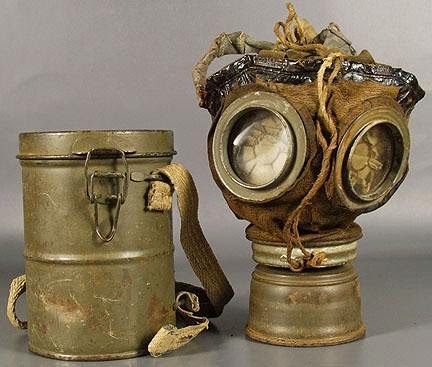
The above two pictures are of the first and second model "Gummimaske"(the generic name people used for this variety of mask). On the left is an early 1915 pattern Gummimaske introduced late in 1915 and widely issued by January 1916 and this specific model is referred to as Bandmaske. On the right is the improved Rahmenmaske introduced during the spring or early summer of 1916. The fit was improved due to the addition of a strap across the top of the forehead and a more rigid frame (Rahmen means frame in German). The mask and filter plate were reduced in size to ensure that less exhaled air would build up inside the mask. WW1 German masks had no exhalation valve and the wearer breathed in and out through the filter. Note that the eye pieces are a bit lower on the improved mask on the right.
Ledermaske with carrying can.

Interior of Ledermaske- Note the interior eye lens inserts. The were made of treated cellulose and intended to prenvent the mask lenses from fogging up. These lens inserts could be changed in the field, unlike the ones for the Gummimaske.

Additional lens inserts- These were stored in a small compartment in the top of the storage cannister.

Two examples of the Ledermaske with interior views.


In mid 1917 or mid 1918 (sources vary) the Germans introduced a snap-on filter attachment designed to counteract the effects of diphenylchlorarsine aka Blue Cross. The filter on the right has this attachment.

Fresh Filter - Top View. A filter was designed to last up to three hours with constant exposure.

Fresh Filter - Bottom View
The above pictures should provide a good introduction to the basic gas masks that were issued to the German soldier during the First World War. There were some additional models that were issued for specific tasks but for our purposes, they are irrelevant.
  

Thursday, December 18, 2014

Der Armee Feldkocher - The Army Field Cooker, Part 1

Although it's widely known that the Allied armies had a variety of field cookers available to them, less is know about the German side. The short answer is yes. It appears that there were at least a couple of models available and like the Allied ones, they appear to have been private purchase. No doubt these were fueled by something simmliar to today's Sterno stoves. Perhaps something similar can be rigged for living history purposes. Please note that the Esbit stoves that you always see either at WWII events or on Ebay were developed around the mid 1930s, after WWI.
  
The "Armee Feldkocher"with the heating element and a frame to hold a mess kit above the flame.

Another view.

Packed up to go.


The "Hindenburg Feldkocher" field cooker.

This one appears to be short and squat, probably a bit more stable.
 
Close up view.

Advertising for the Hindenburg Feld Kocher- It also touts itself as a warming oven and a light.

Cavalry Equipment - Notes from Jürgen Kraus, Part 2

Here are some more notes regarding equipment issue in the German Cavalry as translated from Jürgen Kraus. There are some real nuggets of information here that have never before been published in English (as far as I know). In particular, I would like to draw attention to the fact that at the outbreak of the war in 1914, the cavalry was NOT issued with bread bags, canteens, and Zeltbahns. One would think that these basic items would have been issued to the individual cavlary trooper as was the case with the rest of the German Army. It completely staggers the imagination and I can only speculate as to the thought process behind this.
 
The following are notes based on my translations of passages from Jürgen Kraus’s 3-Volume Work Die feldgraue Uniformierung des deutschen Heeres 1907-1918, pp. 585-587. The translation was made via a computer translating program and as such, has its limitations. I have inserted question marks where I was unable to make sense of the translation. This is just a first attempt so please be patient, my knowledge of the German language is poor.  

Equipment:

Bread bags, canteens, backpacks, and tent equipment (e.g., tent, tent poles, tent stakes, tent rope) were not part of the standard equipment issue for the cavalry. As the war progressed, the absence of this equipment became painfully apparent. 

The bread bag was approved for use in the Prussian Cavalry by official order on January 13, 1915 followed by Bavaria on January 22, 1915, and Saxony and Wurttemberg on January 19, 1915. To address the shortage of canteens, the Bavarian Cavalry received them first by official order on September 14, 1914. The Bavarian Cavalry Division canteens were appeared along the lines of the ones issued to the field artillery with straps. The strap should be worn as short as possible and slung over the left shoulder. These were approved for use in the Prussian Cavalry by official order on February 14, 1914 (?). 
 

On February 17, 1914 (?) by official Prussian order, drinking cups were issued with cavalry canteens; The Saxon official order was issued on March 4, 1915 and the Wurttemberg official order was issued on March 2, 1915. The Bavarian Cavalry sent a notice dated March 9, 1915 indicating that they still lacked drinking cups due to the cavalry being provided with bread bags (?). 

With the official Prussian order on February 19, 1915, all mobile cavalry formations and reserve squadrons were equipped with tent equipment. Tents were to be worn bandolier style over the shoulder. For artillery, the greatcoat was also worn this way (?). In Bavaria, Saxony, and Wurttemberg, this was ordered simultaneously on March 12, 1915.
 
In order to carry their equipment on foot when the cavalry troopers were engaged in the trenches, they first took their saddlebags from their riding equipment. Later, they tried to transport some of their equipment wrapped in a blanket or tent, but pieces were lost. Finally, there was a call for cavalry backpacks. In response, on November 25, 1914 the Bavarian War Ministry ordered 5000 rucksacks for the Bavarian Cavalry Division; the replacement soldiers were also equipped this way as of March 3, 1915. Although equipping cavalrymen with rucksacks presented an unaccustomed image, it became a common one and was also increasing with other contingents (?). The rucksack was difficult to wear while on horseback and as a remedy, using saddlebags was tried on a proposal of the 1st Guard Dragoon Regiment and this was ordered by the Prussian War Ministry on October 3, 1916 and Bavarian War Ministry on October 14, 1916 on a limited basis. These saddlebags had on button that connected both sides of the saddlebags on a pivot and in that way they could carry their greatcoats, mess kit, tent, and tent accessories bag on the back. Saddlebags were then modified by the replacement squadrons at their home stations and sent to the field. Since it was impossible to come to an unambiguous verdict over the effectiveness of the saddlebags of the Bavarian cavalry, the decision was made on June 15, 1917 to postpone the decision until after the war. 

For portable entrenching tools, at the beginning of the war, each squadron was issued 8 small shovels and 8 axes which were fastened in individual cases on their own, without use of the saddle (?) and over 15 wire cutters and 4 folding saws were each carried in a pocket on the coupling (?). This was directed by the Prussian War Ministry on November 8, 1912 and the Bavarian War Ministry on December 4, 1912. The wire cutters were carried by the trumpeters on their saber belts. On November 9, 1914, the Prussian War Ministry ordered the allowances of small shovels to be increased to 100 and axes to 30, each now carried in a sheath, as well as 50 wire cutters and 20 saws; the Bavarian War  Ministry ordered these innovations on December 5, 1914. For a squadron of Schützen cavalry or dismounted cavalry regiment, per the Prussian War Ministry on January 22, 1917 the allowance was 110 small shovels, 8 axes, 25 pick axes, 35  wire cutters, and 2 saws, followed by the Bavarian War Ministry on August 2, 1917.   

Wednesday, December 17, 2014

Die Zeltbahn, Part 1

The Zeltbahn or shelter half was issued to every German soldier (well, it took until late 1914 to issue them to cavalry) and as such, it's an item that ALL unit members should have. Typically, two Zeltbahns were buttoned together to form a small tend in much the same way as was the practice in the US Army. However, often two, three, four, or more were buttoned together to make an expanded shelter and these were nicknamed "Boars' Nests". While we mostly occupy trenches where the proper use of Zeltbahns are limited, we should all know how to set them up as tents.

Originally, these came in a yellow ochre color but in 1915, the color was officially changed to grey (although the yellow ochre variety were issued until the supply was exhaused).Also, just as importantly, Zeltbahns were also used as ponchos (albeit, not great ones) and that's something we should also work on for living history purposes. Unlike the Allies, the Germans had very little in the way of rain protection except for the Zeltbahn.

One of the problems with reproduction Zeltbahns is that their sizes often vary by manufacturer to the point where it's impossible to button them together. Also, some manufacturers use material that's way too thick- this is an item that was meant to be carried, they can't be heavy.
 
 
Diagram of the 1892 pattern Zeltbahn and kit consisting of stakes, poles, rope, and case.

The Zeltbahn Kit -  Each soldier was issued three stakes and three pole sections. The stakes are the 1901 pattern.

The Zeltbahn rope - Each soldier was issued one of these.

Wartime issue Zeltbahn - In 1915, the color was changed from an yellow ochre to grey.

Closeup- Note the maker's stamp, button and buttonhole.

Detail of cord- These were for use in conjunction with the stakes.


Detail with cord used when the Zeltbahn was used as a poncho.


Detail of poncho cord- Note the stitching used as loops to hold the cord.