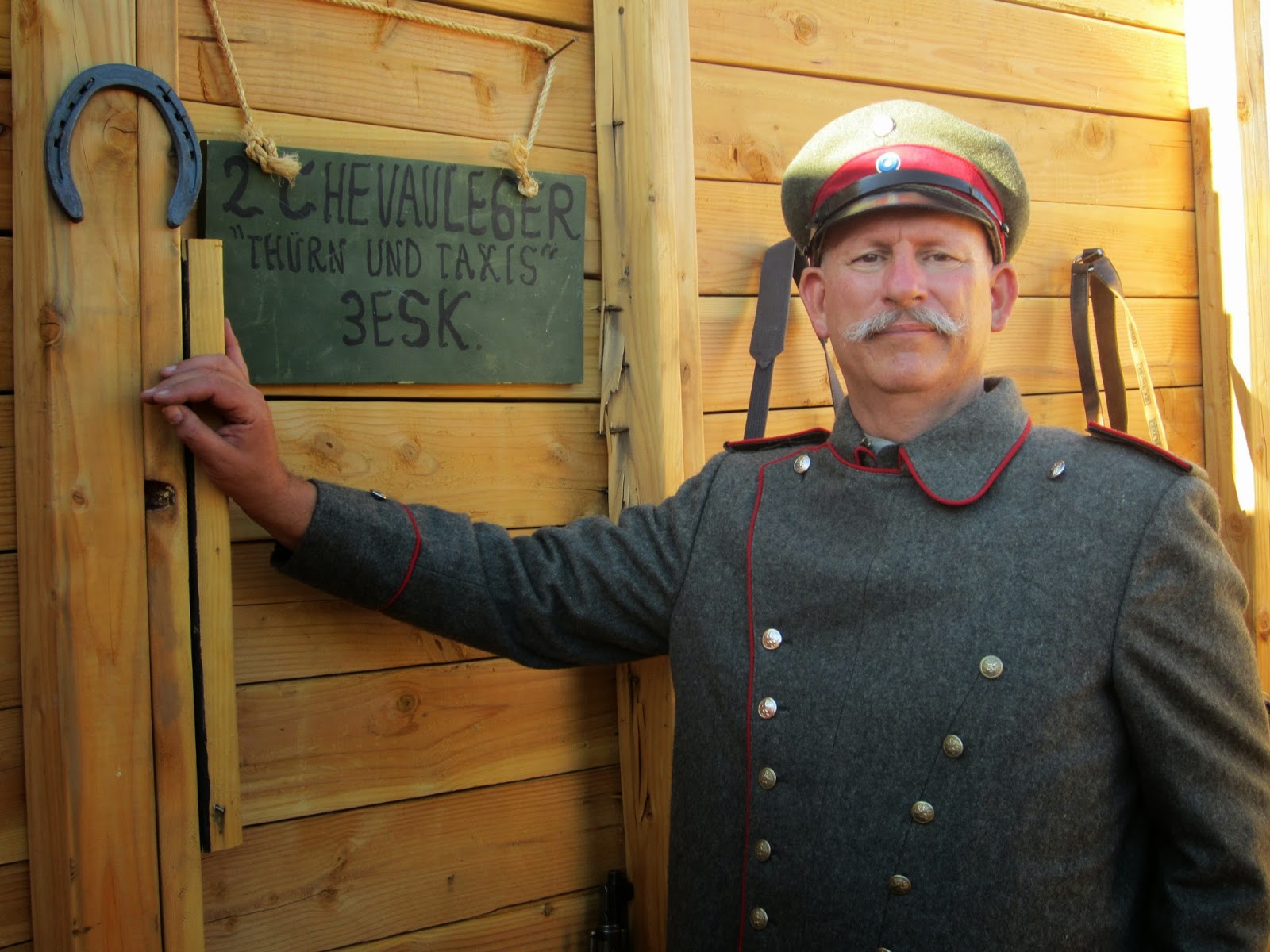
2 Chevauleger Banner

2 Chevauleger Banner

Thursday, December 18, 2014

Cavalry Equipment - Notes from Jürgen Kraus, Part 2

Here are some more notes regarding equipment issue in the German Cavalry as translated from Jürgen Kraus. There are some real nuggets of information here that have never before been published in English (as far as I know). In particular, I would like to draw attention to the fact that at the outbreak of the war in 1914, the cavalry was NOT issued with bread bags, canteens, and Zeltbahns. One would think that these basic items would have been issued to the individual cavlary trooper as was the case with the rest of the German Army. It completely staggers the imagination and I can only speculate as to the thought process behind this.
 
The following are notes based on my translations of passages from Jürgen Kraus’s 3-Volume Work Die feldgraue Uniformierung des deutschen Heeres 1907-1918, pp. 585-587. The translation was made via a computer translating program and as such, has its limitations. I have inserted question marks where I was unable to make sense of the translation. This is just a first attempt so please be patient, my knowledge of the German language is poor.  

Equipment:

Bread bags, canteens, backpacks, and tent equipment (e.g., tent, tent poles, tent stakes, tent rope) were not part of the standard equipment issue for the cavalry. As the war progressed, the absence of this equipment became painfully apparent. 

The bread bag was approved for use in the Prussian Cavalry by official order on January 13, 1915 followed by Bavaria on January 22, 1915, and Saxony and Wurttemberg on January 19, 1915. To address the shortage of canteens, the Bavarian Cavalry received them first by official order on September 14, 1914. The Bavarian Cavalry Division canteens were appeared along the lines of the ones issued to the field artillery with straps. The strap should be worn as short as possible and slung over the left shoulder. These were approved for use in the Prussian Cavalry by official order on February 14, 1914 (?). 
 

On February 17, 1914 (?) by official Prussian order, drinking cups were issued with cavalry canteens; The Saxon official order was issued on March 4, 1915 and the Wurttemberg official order was issued on March 2, 1915. The Bavarian Cavalry sent a notice dated March 9, 1915 indicating that they still lacked drinking cups due to the cavalry being provided with bread bags (?). 

With the official Prussian order on February 19, 1915, all mobile cavalry formations and reserve squadrons were equipped with tent equipment. Tents were to be worn bandolier style over the shoulder. For artillery, the greatcoat was also worn this way (?). In Bavaria, Saxony, and Wurttemberg, this was ordered simultaneously on March 12, 1915.
 
In order to carry their equipment on foot when the cavalry troopers were engaged in the trenches, they first took their saddlebags from their riding equipment. Later, they tried to transport some of their equipment wrapped in a blanket or tent, but pieces were lost. Finally, there was a call for cavalry backpacks. In response, on November 25, 1914 the Bavarian War Ministry ordered 5000 rucksacks for the Bavarian Cavalry Division; the replacement soldiers were also equipped this way as of March 3, 1915. Although equipping cavalrymen with rucksacks presented an unaccustomed image, it became a common one and was also increasing with other contingents (?). The rucksack was difficult to wear while on horseback and as a remedy, using saddlebags was tried on a proposal of the 1st Guard Dragoon Regiment and this was ordered by the Prussian War Ministry on October 3, 1916 and Bavarian War Ministry on October 14, 1916 on a limited basis. These saddlebags had on button that connected both sides of the saddlebags on a pivot and in that way they could carry their greatcoats, mess kit, tent, and tent accessories bag on the back. Saddlebags were then modified by the replacement squadrons at their home stations and sent to the field. Since it was impossible to come to an unambiguous verdict over the effectiveness of the saddlebags of the Bavarian cavalry, the decision was made on June 15, 1917 to postpone the decision until after the war. 

For portable entrenching tools, at the beginning of the war, each squadron was issued 8 small shovels and 8 axes which were fastened in individual cases on their own, without use of the saddle (?) and over 15 wire cutters and 4 folding saws were each carried in a pocket on the coupling (?). This was directed by the Prussian War Ministry on November 8, 1912 and the Bavarian War Ministry on December 4, 1912. The wire cutters were carried by the trumpeters on their saber belts. On November 9, 1914, the Prussian War Ministry ordered the allowances of small shovels to be increased to 100 and axes to 30, each now carried in a sheath, as well as 50 wire cutters and 20 saws; the Bavarian War  Ministry ordered these innovations on December 5, 1914. For a squadron of Schützen cavalry or dismounted cavalry regiment, per the Prussian War Ministry on January 22, 1917 the allowance was 110 small shovels, 8 axes, 25 pick axes, 35  wire cutters, and 2 saws, followed by the Bavarian War Ministry on August 2, 1917.   

Wednesday, December 17, 2014

Die Zeltbahn, Part 1

The Zeltbahn or shelter half was issued to every German soldier (well, it took until late 1914 to issue them to cavalry) and as such, it's an item that ALL unit members should have. Typically, two Zeltbahns were buttoned together to form a small tend in much the same way as was the practice in the US Army. However, often two, three, four, or more were buttoned together to make an expanded shelter and these were nicknamed "Boars' Nests". While we mostly occupy trenches where the proper use of Zeltbahns are limited, we should all know how to set them up as tents.

Originally, these came in a yellow ochre color but in 1915, the color was officially changed to grey (although the yellow ochre variety were issued until the supply was exhaused).Also, just as importantly, Zeltbahns were also used as ponchos (albeit, not great ones) and that's something we should also work on for living history purposes. Unlike the Allies, the Germans had very little in the way of rain protection except for the Zeltbahn.

One of the problems with reproduction Zeltbahns is that their sizes often vary by manufacturer to the point where it's impossible to button them together. Also, some manufacturers use material that's way too thick- this is an item that was meant to be carried, they can't be heavy.
 
 
Diagram of the 1892 pattern Zeltbahn and kit consisting of stakes, poles, rope, and case.

The Zeltbahn Kit -  Each soldier was issued three stakes and three pole sections. The stakes are the 1901 pattern.

The Zeltbahn rope - Each soldier was issued one of these.

Wartime issue Zeltbahn - In 1915, the color was changed from an yellow ochre to grey.

Closeup- Note the maker's stamp, button and buttonhole.

Detail of cord- These were for use in conjunction with the stakes.


Detail with cord used when the Zeltbahn was used as a poncho.


Detail of poncho cord- Note the stitching used as loops to hold the cord.
 

Monday, December 15, 2014

The Blanket/Die Wolldecke, Part 1

The subject of blankets periodically comes up so here are some pictures. Blankets were an item that was typically issued in garrison (i.e. back at the Kaserne) and not intended to be taken out to the field. It was expected that in the field, the solider's greatcoat would be sufficient.
As things turned out, just a greatcoat alone (especially the ones that the German Army started the war with in 1914) were woefully insufficient and in practice, soldiers acquired ("organized") blankets to supplement their greatcoats. This usually worked out pretty well since much of the tended to be static (relatively).
From the information I have gathered, it would seem that there were several varieties of blanket, each usually made with some sort of stripe arrangement. Use seems to also have been made of civilian and captured blankets.


Here is a nice example with dated 1914 and with the proper markings.

Close-Up

Another view of the same blanket.

This soldier has rolled it up and attached it to his Tornister or knapsack.

A squad sleeping with the blankets piled on.
 

German Cavalry Regiments - From Jürgen Kraus


The following are notes based on my translations of passages from Jürgen Kraus’s 3-Volume Work Die feldgraue Uniformierung des deutschen Heeres 1907-1918, pp. 583-585. The translation was made via a computer translating program and as such, has its limitations. I have inserted question marks where I was unable to make sense of the translation. This is just a first attempt so please be patient, my knowledge of the German language is poor.
 
Cavalry Organization:

Cavalry regiments were composed of five squadrons[1] (three of the Bavarian Chevauleger Regiments only had four squadrons) and each regiment had a peacetime establishment of approximately 25 officers, 3 medical officers, 3 veterinary officers, and 750 enlisted men (privates and NCOs). During wartime, cavalry regiments went to the field with four squadrons while the fifth remained at home station (8 officers and 260 enlisted men) and were intended as a source of replacements for the other four squadrons.[2] In the field, the cavalry regiment had a wartime strength of 30 officers and 690 enlisted men. 

After the transition to trench warfare, there was hardly any use for cavalry while on the other hand, there was a great need for replacement horses for the existing artillery formations. Therefore, from October 1916 on, more and more cavalry regiments formally gave up their horses and were instead used for dismounted combat. From November 1917 on, these cavalry regiments received the designation of “Cavalry-Schützen-Regiment”[3] but retained their old active cavalry regimental designation.
 
By spring 1918, 53 cavalry regiments had been formally dismounted (designated as "Kavallerie-Schützen") and 19 Cavalry-Schützen-Regiments were dissolved by the war’s end due to large losses.


[1] A squadron would be equivalent to a company of infantry for organizational purposes. Unlike the US Army, German cavalry lacked the intermediate organizational unit of the battalion.
[2] The fifth squadron was designated as the “Ersatz Eskadron” while the four squadrons in the field were numbered 1 through 4.
[3] The formal term was “Kavallerie-Schützen-Regimenter” which translates into “Cavalry Rifle Regiments”. For ease of understanding, “Cavalry Schützen Regiment” will be used.

Thursday, December 11, 2014

Der Kochgeschirr - The Mess Kit, Part 3

Here are few more pictures of the Kochgeschirr or mess kit and how it ties together with everything else.

Interior of the 1910 Pattern. Note the small lip on the right for securing the spork. 


Mess Kit with infantry pattern Spork placed inside. While this may look like an elegant solution of where to secure the Spork, it's really not. The Spork has a tendency to pop out of it's secure location and rattle around inside the kit making for a lot of noise. In practice, these were often carried either in a pocket or the bread bag.


Another View

Monday, December 8, 2014

The Holiday Season is On!

Looks like the holiday season is on...Horrido!

"Dining at the Ball"

Sunday, December 7, 2014

Christmas Truce

This past weekend, the 2 Chevauleger attended the Great War Historical Society's 1914 Christmas Truce Event. This event attempted to recreate the spontaneous truce that occurred in segments of the Allied/German lines during Christmas 1914 and especially in the British Sector. The event started with a small scale attack on the British lines that rapidly petered out in the face of fierce defensive fire. Then we held a mail call for the German forces followed up by dinner, which we invited our British Komeraden to attend under flag of truce. Later, after dark, we celebrated Christmas by lighting candles for two Christmas trees in no man's land with our British Komeraden and sang Christmas carols around a bonfire (the fire definitely kept the cold at bay).

This event was a bit different than the usual battle event in that the focus was on living history rather than creating battles and overall it was a success although it would have been nice had more British showed up. Below are some pictures from the event:

Group Shot

2 Chevauleger - This is our first event wearing the new 1915 cavalry breeches we had made for us. I am also wearing the new 1910 Chevauleger tunic. Slowly but surely, things are coming together for the unit.

Chevauleger Landschultz

Home Sweet Home
Getting ready for the last big push before Christmas.
The wait....
At the front while others are at home...


Soccer Balls...

A couple of our British Adversaries.

"O Tannenbaum" lit up in all its glory.

Things didn't end so well for this one...